
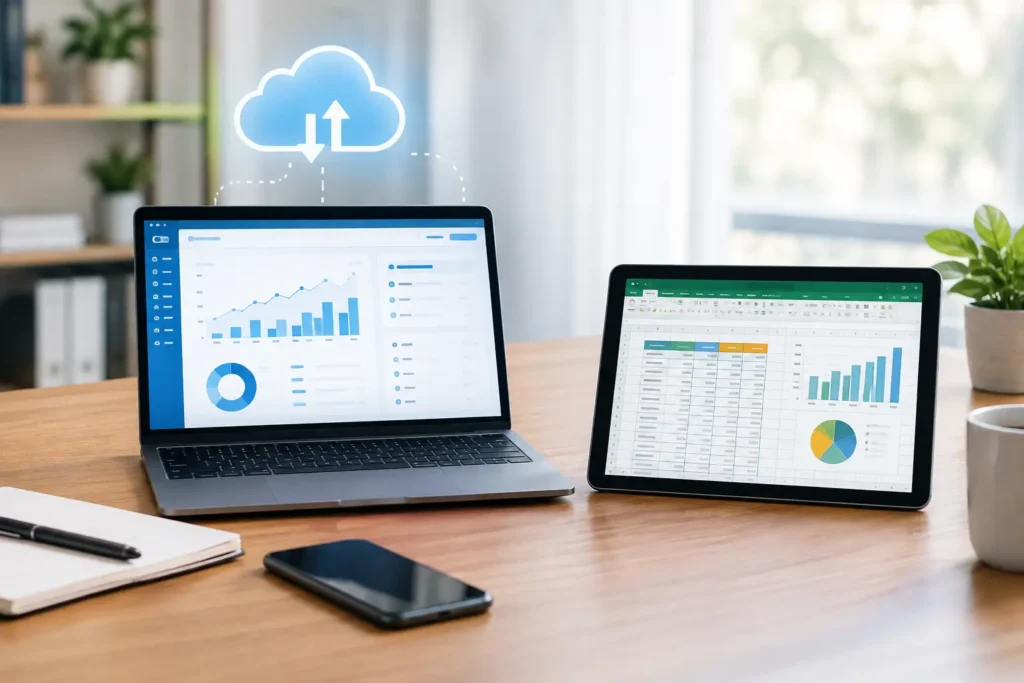
A spreadsheet can feel perfectly adequate when a business has a handful of invoices, a simple expense list, and one person watching the bank account. The decision around cloud accounting versus spreadsheets becomes more pressing when transactions increase, staff need information, or tax and filing deadlines approach. At that point, the question is not simply which tool costs less. It is which approach gives directors reliable financial visibility while keeping the company organized and compliant.
For many Singapore businesses, spreadsheets remain useful working tools. They are familiar, flexible, and quick to start. Cloud accounting software brings structure, connected records, and more consistent reporting. Neither is automatically right for every company, but the operational risks and benefits change considerably as a business grows.
Cloud accounting versus spreadsheets: the practical difference
A spreadsheet is a blank framework. You decide how to categorize income, record expenses, track payments, reconcile bank activity, and prepare reports. That freedom can be helpful for an early-stage founder with low transaction volume and straightforward operations. It can also create inconsistencies when different people update the file or when the business relies on formulas that only one person understands.
Cloud accounting software is designed around an accounting workflow. Sales, purchases, bank transactions, receipts, payments, and financial reports are recorded within a connected system. Users can access current information securely from different locations, with permissions that reflect their roles. Rather than rebuilding reports manually at month-end, the software produces data from the books already maintained during the month.
The difference matters because accounting is not only a record of what happened. It supports decisions about cash flow, profitability, tax obligations, and whether the business can confidently take its next step.
Where spreadsheets continue to work well
Spreadsheets are not a poor choice by default. A newly incorporated company that has limited monthly activity, no inventory, few suppliers, and a simple ownership structure may be able to track initial transactions in a well-maintained spreadsheet. They can also be useful alongside accounting software for budgeting, scenario planning, project estimates, and management analysis.
Their strongest advantage is flexibility. A director can create a customized cash forecast or test pricing assumptions without changing the accounting records. There is no subscription cost for a basic template, and staff often need little training to enter information.
However, flexibility requires discipline. Files need a clear structure, protected formulas, consistent naming, version control, and regular reviews. A spreadsheet that starts as a simple expense tracker can become difficult to audit after several months of changes, copied tabs, and manual adjustments.
For companies required to maintain proper accounting records, the concern is not whether a spreadsheet is permitted. It is whether the records remain complete, accurate, traceable, and ready to support financial statements and tax reporting when needed.
Accuracy is about process, not just formulas
Spreadsheet errors are often small at first: a transaction entered twice, an invoice marked paid in one tab but not another, or a formula that does not extend to the latest row. These issues can distort cash balances and profit figures without being immediately obvious. Manual bank reconciliation can catch some errors, but it depends on someone completing the process consistently.
Cloud accounting can reduce repetitive data entry through bank feeds, invoice creation, receipt capture, and rules for recurring transactions. It also keeps entries tied to the same underlying ledger, so a payment recorded against an invoice is reflected in receivables and reports. This does not eliminate the need for review. A bank transaction still needs the right category, and automated suggestions still need informed oversight.
The practical benefit is a more reliable routine. When records are updated frequently and reconciliations are completed on schedule, directors are less likely to make decisions from outdated or incomplete numbers.
Audit trails and supporting documents
The ability to explain a number matters as much as the number itself. If a tax adviser, auditor, investor, or internal reviewer asks about an expense, the company should be able to trace it to the source document and the accounting treatment used.
In a spreadsheet-based process, invoices and receipts are often stored separately in email folders, shared drives, or paper files. Finding the supporting evidence can become time-consuming. Cloud systems can attach documents to transactions and record who entered or changed information, creating a clearer audit trail.
This structure is especially valuable when responsibilities are shared between founders, finance staff, and an outsourced accounting provider. It reduces the risk that key knowledge sits with one person or in one file on a local computer.
Compliance needs become harder to manage manually
Singapore companies must maintain proper records and meet ongoing obligations, including corporate tax and other filings that may apply to their business. The accounting method should make it easier to produce accurate figures, retain supporting documents, and respond promptly when information is requested.
Spreadsheets can support compliance when they are kept carefully, but they place more responsibility on the business to maintain controls. The company must ensure transactions are recorded completely, classifications are correct, and records are retained in an accessible format. It also needs to watch deadlines independently and prepare the necessary information for filings.
Cloud accounting software does not replace professional judgment on IRAS requirements or tax treatment. What it can do is provide cleaner records, timely reporting, and a more organized handoff to the people preparing accounts and tax filings. For a growing business, that can mean fewer last-minute searches for missing invoices and fewer corrections after the reporting period has closed.
Cost should be measured beyond the subscription fee
At first glance, spreadsheets appear free and cloud accounting has a recurring cost. That comparison is incomplete. The meaningful cost includes the time spent entering transactions, checking formulas, combining files, locating documents, and correcting errors at year-end.
A founder’s time is often the most expensive part of a manual process. If maintaining a spreadsheet takes several hours each month, and still leaves uncertainty about cash flow or overdue invoices, the lower software cost may not be the real savings.
Cloud accounting also has costs beyond the subscription. The company needs an appropriate chart of accounts, clear workflows, user training, and periodic review. Poorly configured software can produce confusing reports just as easily as a poorly designed spreadsheet. The goal is not to buy technology for its own sake. It is to build a finance process that matches the business.
Choose based on complexity, not ambition alone
A business does not need to be large to benefit from cloud accounting. The following situations often signal that a structured system is becoming worthwhile:
- Monthly transaction volume is increasing or bank reconciliation is falling behind.
- More than one person needs access to current financial information.
- The business issues regular invoices, manages supplier bills, or needs to track unpaid amounts.
- Directors need timely cash flow and performance reports to make operating decisions.
- The company is preparing for financing, hiring, expansion, or a more formal outsourced accounting arrangement.
Conversely, a very early-stage company with minimal activity may reasonably begin with a controlled spreadsheet process while establishing its operations. The key is to review that choice regularly. A tool that was suitable six months ago may not be suitable after new customers, employees, payment channels, or regulatory obligations are added.
A sensible transition plan
Moving from spreadsheets does not require recreating every historical detail on day one. Start by selecting a practical conversion date, organizing outstanding invoices and bills, reconciling bank balances, and confirming opening balances. Then establish who approves expenses, who uploads documents, and who reviews the monthly reports.
This is also a good time to separate business and personal transactions, standardize document storage, and define how often records will be updated. Those habits matter regardless of software choice.
For directors who prefer to stay focused on customers and growth, an outsourced accounting partner can manage the regular bookkeeping process while providing clear financial information for review. AlpPeak supports businesses with integrated accounting, tax, compliance, and administrative services so that the back office remains organized as operations develop.
The right choice should leave you with more than a record of past transactions. It should give you confidence that your figures are current, your documents are in order, and your business can respond calmly when the next decision or filing deadline arrives.